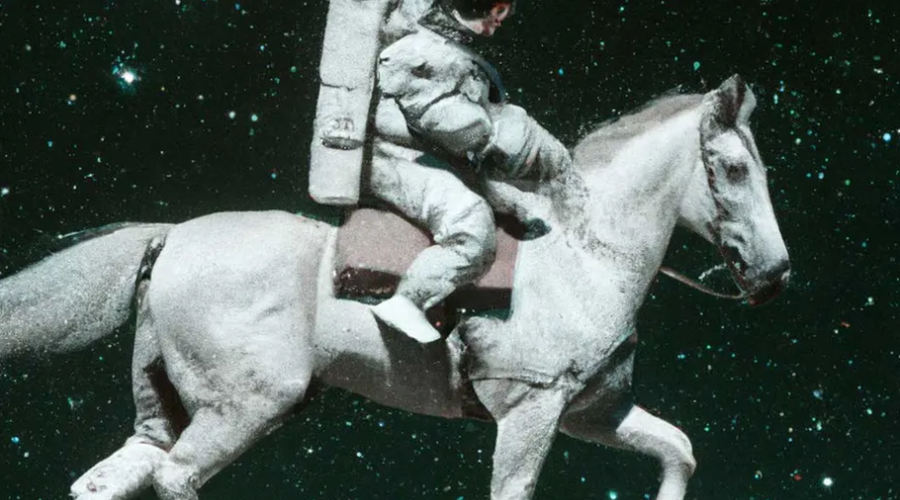
Is AI Killing Art? A Heartless Disruption
Published: 10/23/2022
In the past few years, we have seen a rapid increase in the use of artificial intelligence (AI) in various aspects of our lives. From personal assistants to self-driving cars, AI is becoming more and more commonplace. With the rapid advancements in AI technology, there is no doubt that this trend will continue and cause a disruption in many fields. One particular area where AI is starting to have a significant impact is the world of art. AI is being used to create paintings, sculptures, and even music. While some people see this as a positive development, others are worried that AI will replace human artists.
I should start with a clarification, for the following post, I will be focusing mostly on the art of painting, not art in general. Also, I’m by no means an expert in this topic; this is just curiosity put into the paper.
Let’s begin with the following (hard) question: What is art? When you Google it, you get the following definition:
“Art is the expression or application of human creative skill and imagination, typically in a visual form such as painting or sculpture, producing works to be appreciated primarily for their beauty or emotional power.”
The following video explains how the Dall-e 2 AI works.
https://youtu.be/qTgPSKKjfVg
Dall-e 2 explained by OpenAI.
For me, art (painting) has three main characteristics: first, beauty, or at least, the intention to achieve it. Second, its ability to transmit meaning, and third, mostly how we assign value- social and cultural significance/popularity. Let’s now break down how AI will impact each of these characteristics.
First, AI will make the pursuit of beauty harder for human painters. It will have the accumulated techniques of every painter that has ever lived; it will not make “mistakes” regarding lines, colors, or faces. If a human painter had the same technical ability as the AI, their work would be exactly as they imagined it. On the other hand, it can help democratize beauty, since everyone will be able to create their own pieces based on a simple description of their idea of the concept. For example, this is what Saint George and the Dragon would look like if it was painted by Rene Magritte.
Press enter or click to view the image in full size. Magritte x Saint George and the Dragon — Made by Dall-e with a prompt from @houseofmagritte
Secondly, the meaning an artwork can transmit will be utterly different since AI won’t have the same emotional baggage, social context, or cultural understanding humans have. Nevertheless, meaning is very subjective, so it will be given mostly by the observer, just as beauty is in the eye of the beholder. In this scenario, archetypes -just as the ones in the story from which the above picture is- will play a significant role. These AIs, because of their policy, will not create faces of actual human beings, so you will not be able to ask for a portrait of a loved one.
In my view, AI is only stripping some of the last parts because everyone will be able to create their own art. It will be fun to see the determinants of success in the future world of painting. Will we give more value to AI paintings prompted by professional artists? Despite OpenAI still owning the pieces, you are able to commercialize them and enjoy them personally. So yes, you and I can create artwork with the same skill and style as history’s most important painters, such as Picasso, Dali, etc. Humans are storytelling creatures, so we will be able to find an explanation for almost every element in each piece we create. In my view, despite not being made by an artist, an AI-generated piece could be successful with the right narrative.
With that being said, it is fair to say that AI has already disrupted the art world in many ways. For instance, in October 2018, a painting created by an AI was sold at Christie’s for $432,500. The painting, called “Portrait of Edmond de Belamy”, was created by an algorithm that was fed a dataset of 15,000 portraits. The algorithm then created its own portraits by recombining the features of the images. (More on this, poorly aged article)
Theoretically, just by its sole computing power, this AI has created all possible paintings visible to the human eye. The human eye has only a particular spectrum of colors it can perceive; this is well depicted by the RGB spectrum, which goes from 0 to 999 on red, green, and blue. If you grab, for example, a 1000x1000 pixel blank slate and make all the possible combinations of colors, you will have every possible painting. Nevertheless, combinations are almost infinite, so no need to fear.
This is a 16-million-pixel image with each pixel different in the set of RGB.

In conclusion, artificial intelligence is having a profound impact on the world of art. The most important aspect is that it will empower ordinary people who lack the technical skills to implement their ideas. You can still use different tools to explore this world and comment on your opinion